

Finding the right Employer of Record provider for your global expansion can feel like navigating a maze. You’re dealing with unfamiliar labour laws, tax obligations, and the ever-present question of whether you’ve got compliance sorted in jurisdictions you’ve never operated in before. Get it wrong, and you’re looking at penalties, back payments, and a whole lot of sleepless nights.
The EOR market has grown considerably over the past few years, particularly as remote work has become the norm rather than the exception. Australian companies wanting to hire international talent without setting up local entities in dozens of countries have plenty of options, but not all providers are created equal. Some excel at technology and user experience, others bring deep local compliance expertise, and a few manage to strike a balance between both.
This guide walks through the top ten EOR providers for Australian companies looking to build global teams. We’ve ranked them based on their capabilities, local expertise across multiple jurisdictions, pricing structures, and what actual users have to say about working with them. Whether you’re a startup testing international markets or an established enterprise scaling your team across continents, understanding your options can save you significant time and money.
What is an Employer of Record?
An Employer of Record takes on the legal responsibilities of employing staff on behalf of another company. Think of it as a workaround for businesses that want to hire people in foreign countries without going through the lengthy and expensive process of establishing legal entities in each jurisdiction.
The EOR becomes the official employer on paper. They handle payroll, tax withholdings, statutory contributions, and all the compliance headaches that come with local employment laws. Your company retains control over the employee’s day-to-day work, projects, and performance management. You’re still the boss, but the EOR handles all the administrative and legal complexities in the background.
This arrangement works particularly well for companies hiring their first international employees, testing new markets, or managing remote teams across multiple countries. Rather than navigating unfamiliar labour codes, social security systems, and country-specific payroll requirements yourself, you outsource that expertise to specialists who do this every day.
The Global Employment Landscape
International employment brings a complex web of regulations that vary dramatically from country to country. What’s standard practice in Australia might be completely different in Germany, Singapore, or Brazil. Employment contracts, notice periods, termination procedures, and statutory benefits all operate under different frameworks depending on the jurisdiction.
Labour laws change frequently, and keeping up with amendments across multiple countries can quickly overwhelm HR teams. Some countries require works councils, others mandate specific insurance policies, and many have probation periods or trial arrangements that differ significantly from Australian norms. Even something as straightforward as calculating annual leave becomes complicated when you’re dealing with different accrual methods and public holiday schedules.
Tax and social security obligations add another layer of complexity. Most countries operate pay-as-you-earn systems similar to Australia’s PAYG, but the rates, thresholds, and reporting requirements vary. Social security contributions might be split between employer and employee, and the percentages can be substantial. In some European countries, total employment costs can run 40-50% above base salary once all statutory contributions are included.
Immigration adds yet another dimension when you’re looking to relocate Australian staff overseas or hire foreign nationals in their home countries. Visa requirements, work permits, and residency obligations differ widely. Some countries make it straightforward, others require extensive documentation and labour market testing. A good EOR provider can manage all of this, but capabilities vary significantly across providers.
Top 10 EOR Companies in Australia: Detailed Rankings
1. Safeguard Global

Safeguard Global has supported over 1,500 organisations in managing talent across 187 countries for more than 18 years, establishing a depth of experience that newer entrants can’t match. After divesting their enterprise payroll division in 2025, they’ve refocused to serve medium to large businesses, making them particularly well-suited for Australian high tech companies and other forward-thinking startups looking to scale into international markets.
They operate in 187 countries with a team of 400+ in-country experts who bring deep understanding of local labour laws and culture across your key expansion markets. Whether you’re hiring in the USA, UK, Canada, Singapore, Brazil, Poland, or India, their local teams provide on-the-ground expertise.
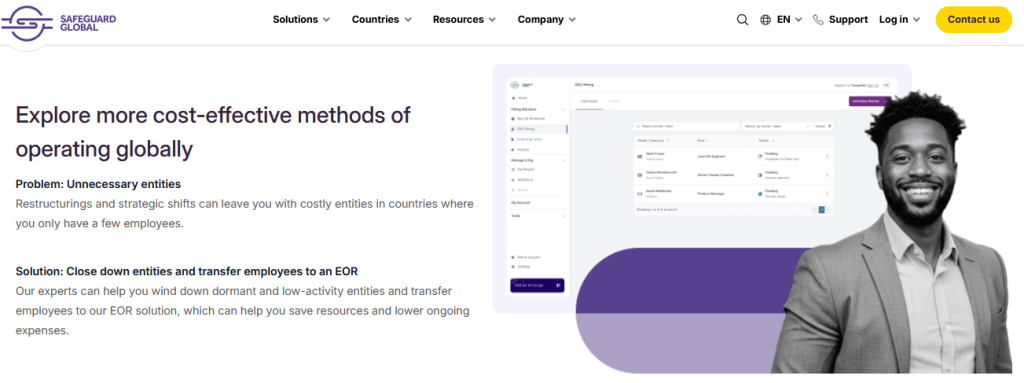
Recently, they won the Gold Award for Best Employer of Record (EOR) Service Provider at the HRM Asia Readers’ Choice Awards 2025, recognised for their work in workforce solutions. This recognition underscores their “human when it matters” approach, which balances modern automation with hands-on, in-country expertise across the diverse markets Australian companies typically expand into.
Their service offering is comprehensive. Beyond standard payroll and benefits administration across multiple countries, they provide immigration support for visa sponsorships in markets like the Hong Kong and South Korea, equipment provisioning for new hires regardless of location, and assistance with terminations when relationships don’t work out. Their compliance team actively monitors changes to employment law across all your operating jurisdictions and proactively updates you when new obligations come into effect, whether that’s changes to Brazilian labour courts, updates to Polish employment contracts, or shifts in Indian payroll regulations.
Safeguard Global excels in handling the vastly different employment frameworks across markets. They’ve built expertise across numerous countries and can advise on appropriate employment structures for different roles and jurisdictions. This matters because each market has its own risks: employee misclassification in the USA carries different consequences than contract violations in Brazil or award interpretation issues that might arise if you maintain any Australian operations.
The platform offers extensive reporting capabilities with a 100% compliance-first approach designed to reduce administrative workload for HR teams managing international operations. You can access real-time data on your global workforce, run custom reports across multiple countries, and integrate with existing HRIS systems through their API. The employee experience is solid, with self-service portals that allow workers to access payslips, update personal information, and manage their leave balances, regardless of whether they’re based in Mumbai, Warsaw, or San Francisco.
Pricing sits at the higher end of the market, typically ranging from $500 to $800 AUD per employee per month depending on service levels, location, and volume. There’s usually a setup fee involved, and contracts tend to run for 12 months. For Australian companies that value established expertise and comprehensive service across multiple international markets, the premium is often worthwhile.
2. Native Teams
Native Teams has positioned itself as a more agile alternative to some of the larger, more established players. They’ve built a modern platform that emphasises user experience and transparency, something that resonates with tech companies and startups who want to move quickly.
Their onboarding process is notably faster than many competitors, often getting new employees onto the payroll within one to two weeks rather than the month or longer that some providers require. This speed can be critical when you’re trying to secure talent in competitive markets or establish operations in new territories.
The platform is intuitive and genuinely easy to use. Both employers and employees report positive experiences with the interface, which handles everything from document uploads to leave requests without the clunkiness that plagues some older systems. Mobile access works well, which matters when managing teams across different locations and time zones.
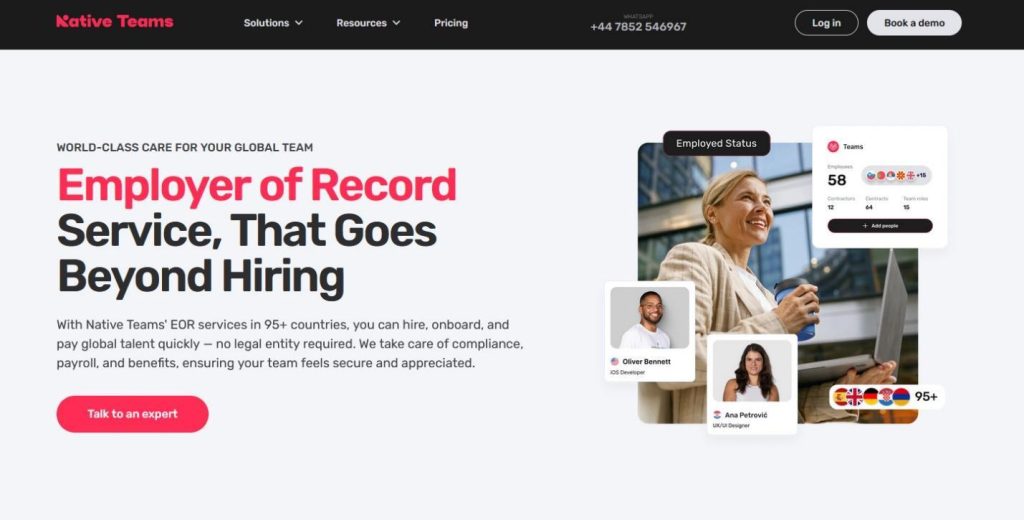
Native Teams handles local compliance requirements effectively in the countries where they operate, with automated payroll and benefits management. They’ve established partnerships with relevant providers to streamline statutory contributions and administrative processes. Their compliance approach is solid, though they don’t claim the same depth of country-specific expertise as providers like Safeguard Global who’ve been doing this for decades.
Pricing is more transparent than many competitors, with costs typically falling between $300 and $500 AUD per employee per month. Setup fees are minimal, and contracts are flexible without the lengthy lock-in periods that some providers insist on. For companies that prioritise technology and speed over decades of establishment, Native Teams represents strong value.
3. The Polyglot Group
The Polyglot Group brings an interesting angle to the EOR market. They specialise in multilingual and international workforce management, which can be particularly valuable for companies expanding into diverse markets or managing employees across multiple countries.
Their service coverage is comprehensive, handling the full spectrum of EOR responsibilities from payroll through to compliance monitoring. They maintain local entities in their operating countries and have staff who understand the nuances of local employment legislation and jurisdiction-specific requirements.
Where The Polyglot Group differentiates itself is in their handling of visa sponsorships and immigration compliance. If you’re establishing operations in new markets or relocating employees internationally, their expertise in managing the visa process alongside employment obligations can simplify what would otherwise be parallel but disconnected workstreams.
The technology platform is functional rather than cutting-edge. It handles the necessary tasks competently without offering the sleek user experience that newer providers emphasise. For some clients, particularly those focused more on service quality and personal relationships than interface design, this represents a reasonable trade-off.
Pricing typically ranges from $350 to $550 AUD per employee per month, with standard setup fees and generally 12-month contract terms. Their value proposition centres on the combination of EOR services with language and cultural expertise that other providers may not offer.
4. Employment Hero (Australian-Founded)

Employment Hero occupies a unique position in this list as an Australian-founded company that has expanded from its origins as an HR software provider into offering full EOR services. This local heritage means they understand Australian workplace culture thoroughly, though their platform now serves companies expanding internationally as well.
The platform is genuinely excellent. Employment Hero has invested heavily in creating an all-in-one system that handles not only EOR requirements but broader HR functions like performance management, learning and development, and employee engagement tools. If you want a comprehensive solution rather than a narrow EOR service, Employment Hero delivers.
Their compliance expertise across their operating markets is strong. Being Australian-founded means they’ve built their core systems around local regulations before expanding internationally, which shows in the quality of their compliance support and the confidence with which they handle complex employment situations.
Local customer support is a significant advantage for Australian companies. You’re dealing with teams in Australian time zones who understand local context and can respond to urgent queries without timezone delays. Implementation is typically quick, running one to two weeks for standard engagements.
Pricing is competitive, generally falling between $250 and $450 AUD per employee per month. The modular nature of their platform means you can add additional HR services as needed, though this can increase costs. Setup fees are minimal and contract terms are flexible. For companies that value local expertise and comprehensive HR capabilities beyond basic EOR functions, Employment Hero represents excellent value.
5. SDP Solutions
SDP Solutions brings a consultancy approach to EOR services. They’re less about mass-market technology platforms and more about personalised service and complex problem-solving. This appeals to companies with unusual requirements or challenging compliance situations in their target markets.
Their service offering covers all standard EOR functions with particular strength in handling difficult employment classifications and local labour agreement navigation. When you’ve got employees covered by complex instruments or unusual working arrangements across different jurisdictions, SDP Solutions’ consultative approach can be valuable.
They maintain local entities and have experienced compliance professionals who actively monitor regulatory developments. Their reporting on changes to employment legislation is detailed and actionable rather than generic updates that require interpretation.
The technology platform is adequate but not a selling point. SDP Solutions clients typically choose them for the human expertise and service quality rather than sleek interfaces. This works well for some organisations but can feel dated compared to more modern competitors.
Pricing sits in the $400 to $600 AUD range per employee per month, reflecting the consultative service model. Setup costs vary depending on complexity, and contracts generally run for 12 months. Companies dealing with complex compliance scenarios often find the premium worthwhile.
6. Asanify

Asanify represents the newer generation of EOR providers building technology-first solutions with global reach. They’ve grown quickly by offering competitive pricing and emphasising user experience.
The platform is modern and reasonably intuitive. Asanify has focused on creating smooth onboarding flows and clear interfaces that reduce the learning curve for both employers and employees. Their mobile experience is solid, recognising that many workers prefer to handle administrative tasks on their phones.
Compliance capabilities across their operating markets are good though perhaps not as deep as providers with longer histories in specific jurisdictions. They handle all the statutory requirements competently, including local payroll reporting and statutory benefits management. For straightforward employment situations, their compliance support is entirely adequate.
Where Asanify particularly excels is in multi-country scenarios. If you’re expanding across Asia-Pacific or globally, their platform provides consistent experience and centralised management across jurisdictions. The ability to manage diverse international teams through a single interface has clear operational benefits for Australian companies building presence in multiple markets.
Pricing ranges from $300 to $500 AUD per employee per month with minimal setup costs and flexible contract terms. For companies prioritising cost-effectiveness and modern technology, particularly those with multi-country requirements, Asanify offers strong value.
7. Deel

Deel has become one of the most recognisable names in the global EOR space through aggressive growth and heavy investment in technology and marketing. Their platform is genuinely impressive, offering slick interfaces and extensive self-service capabilities.
The onboarding speed is notable. Deel can typically get new employees set up within a week, faster than most competitors. Their automated workflows and digital-first processes eliminate much of the back-and-forth that slower providers require.
Across their operating markets, Deel handles all statutory compliance requirements competently. They’ve built local expertise in numerous countries though it may not match the depth of providers who’ve focused specifically on individual markets for longer periods. For standard employment situations, their capabilities are entirely sufficient. If you encounter unusual employment classifications or complex local labour law scenarios, you might find their guidance less assured than what you’d get from specialists with deeper market-specific experience.
Where Deel really stands out is in the breadth of services beyond traditional EOR. They offer contractor management, equipment purchasing and shipping, immigration support, and various add-on services through a single platform. This comprehensiveness can simplify operations considerably for Australian companies managing diverse workforce types across multiple countries.
The scale of their operations can be a double-edged sword. While their global reach is impressive, some clients report that customer service responsiveness suffers compared to smaller, more focused providers. Support queries can take longer to resolve, and you may find yourself dealing with different representatives who lack context on your specific situation. The heavy automation, while efficient, can feel impersonal when you need nuanced advice or want to discuss complex employment situations.
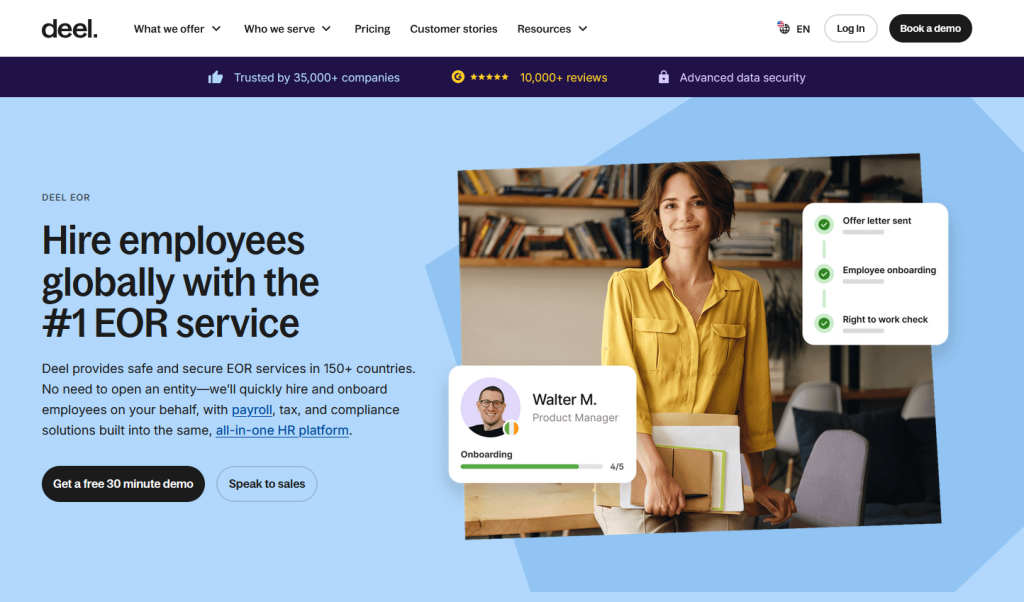
Pricing is competitive at $350 to $500 AUD per employee per month with no setup fees and flexible contracts. Their per-service pricing model means you only pay for what you use, though costs can accumulate once you start adding services beyond basic EOR. Equipment management, immigration support, and various add-ons can make the total expense significantly higher than the base rate suggests. For companies that value technology, speed, and comprehensive global capabilities, Deel represents strong value for international expansion, provided you’re comfortable with a more automated, less relationship-driven service model.
8. Papaya Global

Papaya Global positions itself at the enterprise end of the market, offering comprehensive global workforce management capabilities alongside traditional EOR services. They’ve built robust compliance infrastructure and invested heavily in their technology platform.
Their capabilities across operating markets are solid, covering all necessary compliance requirements with experienced local teams managing the details. Papaya’s strength lies in handling complex, large-scale implementations where you’re managing significant employee numbers across multiple countries simultaneously.
The platform offers extensive reporting and analytics capabilities that appeal to larger organisations with sophisticated workforce planning requirements. Integration options are comprehensive, allowing connection with major HRIS and financial systems through well-documented APIs.
Customer support includes dedicated account management for larger clients, providing consistent points of contact who understand your specific organisational context. This relationship-based approach suits enterprises better than it does smaller companies who may not warrant dedicated resources.
The enterprise focus means smaller organisations may find themselves underserved. If you’re expanding with just a handful of employees in each market, you might not receive the same attention or responsiveness that Papaya’s larger clients enjoy. The platform’s extensive features can also feel like overkill when you need straightforward EOR services without complex workforce analytics.
9. WorkMotion

WorkMotion has grown steadily by focusing on European markets but has expanded coverage to include Australia and other regions with reasonable capabilities. They bring a balanced approach that combines decent technology with solid service.
Their platform is modern without being groundbreaking, offering clean interfaces and straightforward workflows that get the job done effectively. The employee experience is positive, with good self-service capabilities and responsive support when issues arise.
Across their operating markets, WorkMotion provides comprehensive EOR services including payroll, benefits administration, and compliance management. They’ve built local expertise and maintain entities that allow them to employ staff properly under local law. Their compliance handling is solid for standard situations, though their relatively recent expansion into some markets means they may lack the depth of knowledge that longer-established providers offer when complex scenarios arise.
Equipment provisioning and immigration support are available, which can simplify the logistics of setting up new hires across borders. Implementation timeframes are reasonable, typically running one to three weeks depending on complexity.
Pricing falls in the $350 to $550 AUD range per employee per month with manageable setup costs and flexible contracts. WorkMotion appeals to Australian companies seeking reliable service at reasonable prices for their international expansion, without needing the most cutting-edge technology or deepest market-specific expertise. Their European strength makes them particularly suitable for companies expanding into those markets.
10. Lano

Lano rounds out our list as a flexible, cost-effective option that emphasises simplicity and transparency. They’ve built a straightforward platform that handles essential EOR functions without unnecessary complexity.
The user interface is clean and easy to navigate. Lano has clearly thought about user experience and created workflows that make sense to people who aren’t HR specialists. This accessibility can be valuable for smaller teams or companies where HR isn’t heavily resourced.
Their compliance capabilities across operating markets cover all the basics. Lano handles local payroll reporting, statutory benefits, and standard employment requirements competently. For companies with straightforward employment needs, their service level is entirely adequate. More complex scenarios involving unusual employment classifications or intricate local labour agreements may push the boundaries of their expertise.
The platform includes contractor management capabilities alongside EOR services, which can be useful for companies managing mixed workforce types across different countries. This flexibility allows you to bring on employees or contractors through the same system as you expand internationally.
Customer support, while generally responsive, operates on a smaller scale than enterprise-focused providers. If you need extensive hand-holding or immediate resolution of complex issues across multiple time zones, you might find their resources stretched compared to larger competitors.
Pricing is competitive at $300 to $500 AUD per employee per month with no setup fees and flexible contract terms. For Australian companies testing new markets or expanding with straightforward employment requirements, Lano offers good value with minimal commitment required.
Making Your Decision
Choosing an EOR provider comes down to matching their strengths with your specific needs. A startup hiring its first two Australian employees has very different requirements from an enterprise managing hundreds of workers across multiple jurisdictions.
Technology matters more to some organisations than others. If your team is comfortable with digital tools and values slick interfaces, providers like Deel, Native Teams, or Employment Hero will feel more natural. If you prefer human relationships and consultative support over cutting-edge platforms, SDP Solutions or The Polyglot Group may suit better.
Local expertise becomes critical when you’re dealing with complex Modern Award classifications, enterprise agreements, or unusual employment arrangements. Providers like Employment Hero and Safeguard Global bring deeper Australian-specific knowledge that can prevent costly mistakes.
Pricing varies significantly both in absolute terms and in what’s included. Some providers bundle comprehensive services into their base fees while others charge separately for immigration support, equipment provisioning, and other add-ons. Understanding total cost of ownership matters more than comparing headline per-employee rates.
Contract flexibility ranges from highly rigid 12-month lock-ins to entirely flexible arrangements where you can scale up or down freely. Consider your confidence in employee number projections and whether you value the ability to change direction quickly.
Table 5: Support and Service Quality
| Provider | Years in Service | Countries Covered | Local Australian Support | Dedicated Account Manager | Training Provided |
| Safeguard Global | 18+years (founded ~2008) | 187+ countries supported | Yes – local Australian team | Yes | Comprehensive onboarding & local expertise |
| Deel | ~5+ years (founded 2019) | 150+ countries supported | Limited | Optional / tiered | Self-serve + guided workflows (Deel Platform) |
| Papaya Global | ~8–9 years (founded 2016) | 160+ countries supported | Limited | Yes (tiered) | Comprehensive (platform + service) |
| Lano | ~few years (established 2020+) | 170+ countries supported | Optional | Optional | Standard platform training |
| The Polyglot Group | Not publicly disclosed | Not published | Yes (operates in Australia) | Yes | Good (onboarding services) |
| Employment Hero (Global Teams) | ~10 years (founded 2014; Global Teams later) | Australia + global options | Yes (Australia) | Optional | Excellent platform onboarding |
| Asanify | ~few years (established ~2019+) | Not published | Optional | Optional | Good onboarding |
| SDP Solutions | ~20+ years (since ~2004) | Global (via partners) | Yes (Australian HQ) | Yes | Standard (payroll + compliance) |
| WorkMotion | Not published | ~160+ countries focus | Limited | Yes | Good general training |
Where Things Are Heading
The Australian EOR market is changing quickly, but not in a flashy way. What is really happening is increased competition. More providers are entering the space, pricing is becoming more competitive, and service quality is gradually improving as a result. Established players are being forced to upgrade their platforms and processes, not because it looks good in marketing, but because buyers now expect smoother systems and fewer excuses.
What is not getting simpler is compliance. Australian employment law continues to tighten and evolve. Changes around casual employment definitions, ongoing industrial relations reform, and regular superannuation increases mean there is more to get wrong than ever before. For business owners, this is where a good EOR earns their fee. They are expected to absorb that complexity and keep you out of trouble, quietly and consistently.
Another shift is that multi-country capability is no longer impressive on its own. Many providers now offer coverage across dozens or even hundreds of countries. Buyers increasingly assume this as a baseline. Providers that only focus on Australia will need to deliver genuinely strong local expertise, faster support, or better service to stay relevant. Simply being “local” is no longer enough.
Pricing pressure is also unlikely to ease. Technology has lowered operational costs and new entrants are happy to compete aggressively on price. This is good news for buyers, but it does mean you should be cautious of deals that look too cheap. If a provider cannot sustain their pricing model, the risk eventually lands with you.
Finding What Actually Works for Your Business
There is no single best EOR provider for Australia. The right choice depends on how your business actually operates, its size and what are your expansion plans for the future.
Safeguard Global would be an ideal choice for larger or more complex organisations employing 50+ people that need depth, structure, and strong compliance coverage. With their 18 years of experience and presence in all major countries, they are a safe bet for any company who plans to scale up. Employment Hero appeals to businesses that value Australian familiarity and an integrated platform approach. Deel works well for fast-moving companies that prioritise speed, automation, and self-service, but lacks personality and would be suitable for rather smaller teams. Native Teams sits somewhere in the middle, balancing modern technology with hands-on support. Other providers in the market each have strengths that make sense for specific scenarios.
Before talking to sales teams, be honest with yourself. How many people are you really planning to hire in the next 12 months. How confident is your internal HR or finance capability. Are your arrangements straightforward, or do you expect edge cases and complexity. How sensitive are you to price. Do you want a platform you mostly run yourself, or a provider who does more of the heavy lifting.
When you speak to providers, pay attention to how they explain things, not just what they promise. Clear answers, realistic timelines, and a willingness to talk through limitations are better signs than big claims. This is a long-term relationship involving payroll, tax, and compliance. If communication feels vague or rushed at the start, it rarely improves later.
If possible, speak to other businesses like yours. References are useful, particularly around implementation, support responsiveness, and how issues are handled when something goes wrong. Those details matter far more than feature lists once you are live.
A good EOR should reduce stress, not introduce new uncertainty. When chosen carefully, they allow you to hire in employees outside of Australia with confidence and focus on growing your business rather than constantly second-guessing compliance decisions. Taking a bit more time upfront is usually far cheaper than changing providers later.
